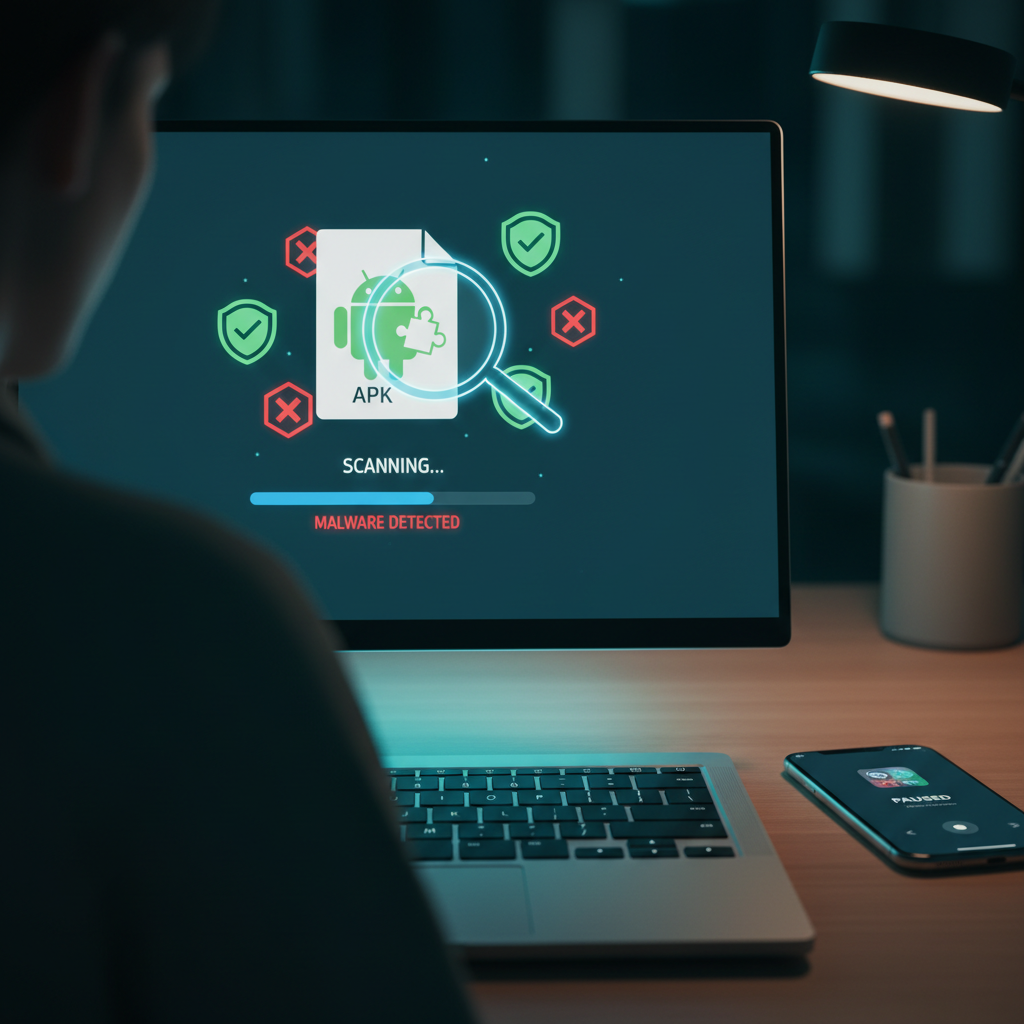
You found the APK you wanted, but before it goes anywhere near your phone, one question matters: is it clean? Checking an APK for malware is free, fast, and worth the habit. Mobile threats are not rare. Kaspersky reported blocking tens of millions of mobile malware, adware, and riskware attacks in a single year, and Google said it stopped more than 2 million policy-violating apps from reaching the Play Store in a recent year. Files you sideload never pass that review, so the scan is on you.
This guide covers five free methods to check any APK for malware, from a thirty-second online scan to reading the app's permissions yourself. Use one for a quick gut check or stack several for files you are unsure about.
The trouble people hit is not a lack of tools. It is trusting a single green checkmark, scanning after they have already installed, or assuming a familiar app name means a clean file. A repackaged app can wear a trusted name and still carry spyware, which is exactly what these methods are built to catch.
Method 1: Scan With a Multi-Engine Online Scanner
The single most useful check is a multi-engine scanner that runs your file past dozens of antivirus engines at once. Upload the APK, wait a moment, and read the verdict. A handful of detections across reputable engines is a clear signal to delete the file. Zero detections is reassuring but not absolute, because a brand-new variant may not be recognized yet.
Treat this as your first filter. It is fast, free, and catches the large share of threats that are already known. Always scan before you install, never after.
Method 2: Let Google Play Protect Do a Pass
Play Protect is built into Android and scans sideloaded apps at install time, not just apps from the Play Store. Keep it enabled. When you install an APK, it checks the file against Google's threat data and warns you if something is wrong. It is automatic and costs you nothing, which makes it a sensible second layer behind an online scan.
Some unsafe guides tell you to switch Play Protect off to silence warnings. Do not. Those warnings are the point.
Method 3: Verify the Developer Signature
Malware is frequently a real app that was repackaged and re-signed by an attacker. The signature exposes that. Use a free signature-viewer app to read the signing certificate and compare it to a known-good copy of the same app. If the certificate does not match the genuine developer, the file has been tampered with, even if a scanner shows nothing. We go deeper in how to verify an APK is safe.
Method 4: Read the Permissions in the Manifest
A free APK-info app will list every permission the package requests, pulled from its manifest. This is where intent hides. Ask whether each permission fits the app's job. A photo editor needing storage is normal. A photo editor demanding SMS, call logs, contacts, and accessibility access is not. Accessibility and device-admin requests deserve special suspicion, because malware abuses them to read your screen and resist removal.
Method 5: Check the Source and Reputation
Where a file comes from is itself a signal. A curated catalog that signature-pins and malware-scans every upload, like APK Store's Verified library, has already run the checks above before the file reaches you. An ad-heavy download page that wraps files in extra installers has not. Cross-check the package name, the developer, and the version against a trusted listing such as the official app page for the app you want. A version that does not exist anywhere reputable is a warning on its own.
Warning Signs After You Install
A pre-install scan is your first defense, but some threats only reveal themselves once an app is running. Watching for these signs lets you catch and remove something a scan missed.
Sudden battery drain or heat
An app that quietly mines, tracks, or beacons home can drain your battery and warm your phone even when idle. Check battery usage by app in settings if something feels off after a new install.
Unexpected ads and pop-ups
Aggressive ads on your home screen or in unrelated apps often trace back to adware bundled into a recent sideload. If ads appear outside the app that should show them, that app is the likely source.
Unusual data use or new permissions
A spike in background data, or an app that asks for accessibility or device-admin access after install, both warrant a closer look. Malware frequently escalates its access once it is already on the phone.
Apps you do not remember installing
Some malicious packages drop additional apps. If an icon you never installed appears, treat it as a strong signal and remove both it and the app you installed just before it showed up.
The Challenges of Catching Mobile Malware
No single method is perfect, and knowing the gaps keeps you honest about what a clean result really means.
Zero detections is not proof of safety
Scanners recognize known threats. A freshly built variant can slip past every engine for a while. A clean scan lowers risk but does not guarantee a file is harmless, so weigh it with the source and signature.
Valid signatures on fake apps
A re-signed malicious app still has a valid signature, just the wrong one. The check that matters is whether the certificate matches the genuine developer, not whether a signature is present at all.
Permissions abused after install
Some apps request modest permissions, then misuse them or pull extra code later. Watch behavior after install too: sudden battery drain, unexpected ads, or data use can mean trouble a pre-install scan could not see.
Bundled installers and adware
Sketchy sites wrap a real APK inside an installer that adds adware. The wrapper, not the app, is the problem. Downloading the raw, scanned file from a curated source avoids this entirely.
Stack the Layers and Trust the Pattern
The reliable approach is not one perfect test. It is a stack: scan the file online, keep Play Protect on, verify the signature, read the permissions, and weigh the source. When all five line up clean, the file is a measured risk worth installing. When even one raises a flag, stop and find a better copy. The deciding question is never whether APKs carry malware in general. It is whether this exact file passed every layer you ran. For files where you would rather skip the manual work, the scanned, signature-pinned Verified library runs these checks before the download ever reaches you.
Frequently Asked Questions (FAQs)
How can I scan an APK for malware before installing?
Upload the file to a free multi-engine online scanner, which checks it against dozens of antivirus engines at once. Do this before you install, never after, and treat several detections from reputable engines as a clear reason to delete the file.
Does a clean scan mean the APK is completely safe?
No. Scanners catch known threats, so a brand-new variant can pass undetected. A clean scan lowers risk but is not proof. Combine it with a signature check, a permissions review, and a trusted source for a fuller picture.
Can Google Play Protect scan sideloaded apps?
Yes. Play Protect scans apps installed from outside the Play Store at install time and warns you if it finds a problem. Keep it enabled as an automatic layer, and avoid any guide that tells you to disable it.
What permissions are a sign of malware in an APK?
Be wary of SMS, call logs, contacts, accessibility services, and device-admin access on apps with no clear need for them. Accessibility and device-admin requests are especially abused by malware to read your screen and resist removal.
Is it safer to download APKs from a curated store?
Yes. A curated source that signature-pins and malware-scans every file runs the key checks before the download reaches you and keeps version history. It lowers your risk compared with an unknown search result, though no source eliminates risk entirely.